
Finally, USL Premier
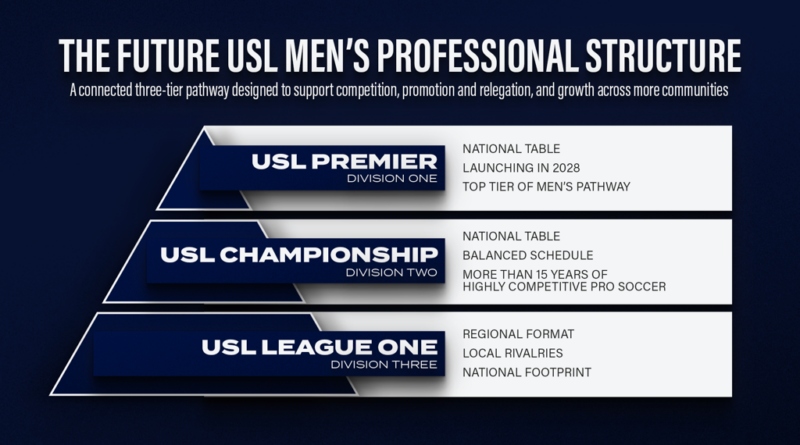
USL Premier is finally official. USL’s foray into the Division 1 men’s pro league business follows the English-inspired naming convention of the USL Championship and USL League One, as expected. USL Premier will act as the top level in a three-tier pyramid with promotion and relegation allowing clubs to move up and down on sporting merit.
While some may question the wisdom of a head-on challenge to Major League Soccer, it was in fact the establishment of third division MLS Next Pro and the talk of a potential second division MLS tier that essentially forced USL’s hand in this direction. If MLS is going to compete with USL at the lower division pro level, it can be argued that USL needs a top tier to make itself a viable alternative to MLS for potential expansion teams – and perhaps even to keep its existing teams from bolting to the MLS system. Further, the introduction of promotion and relegation across its three tier pyramid gives USL differentiation from MLS as a product closer in spirit to the global game rather than soccer presented within an American sports league structure. As have seen in the past, the one constant in USL pro soccer seems to the “soccer wars” between competing pro leagues (for last decade’s edition, see the similarly named book by Kartik Krishnaiyer).
There is clearly a lot of work to do before USL Premier launches in 2028. The USL’s press release laid out some of the basics that have already been figured out. USL Premier will have 20 teams in a national single table and a balanced scheduled. The USL Championship will mirror that structure. USL League One will move to regional conferences and be able to support more than 20 teams.
“USL Premier is a defining piece of our long-term vision for the men’s game,” said Alec Papadakis, CEO of the United Soccer League. “We’ve built a multi-tier professional system that is both scalable and rooted in communities. By establishing a clear structure, we’re creating a strong foundation for clubs, players, and fans, and unlocking meaningful opportunities for stakeholders and investors as we continue to grow the game and prepare to introduce promotion and relegation.”
A little more insight was reported by The Athletic, who add that USL Premier may start with 12 to 14 clubs, and the initial implementation of promotion/relegation will see two clubs up and two down. Then as the league expands to its goal of 20 teams, three teams will promote and relegate each season. It is suggested that around 8 current USL Championship teams will move up to USL Premier, with expansion teams filling out the ranks. Some of this is fluid, and will be discussed further at a February 2026 owners meeting according to The Athletic.
It may seem odd that only 8 teams from the current USL Championship will go up to USL Premier initially, but the USSF’s Pro League Standards could be a factor. A Division 1 men’s outdoor pro league is required to have at least 12 teams to start, and then 14 teams by year 3. There must be teams in the US Eastern, Central and Pacific time zones. 75% of teams must play in metropolitan markets with at least 1,000,000 people. Stadiums must seat at least 15,000. A performance bond of $1,000,000 per team is required, or $20,000,000 for the league. Clubs must have a principal owner holding at least a 35% interest in the club, that has a net worth of $40 million or greater, while the combined ownership group must have a net worth of $70,000,000 or more. There are other requirements, but these are the key ones that may be hurdles for some of the existing USL Championship clubs.
It may seem somewhat disappointing that expansion teams could make up a lot of USL Premier, but there is a case for it from a revenue perspective beyond just expansion fees. While the USL has a strong core of clubs in mid-tier TV markets, only Oakland Roots represent a team in a top 10 TV market that is also viable from a Division 1 stadium requirements perspective. While USL is adding Atletico Dallas before 2028, it also may make sense for USL to have expansion teams in some of the largest media markets as part of the mix for USL Premier, in order to attract a TV deal that will help fund the teams and the pyramid system. While Brooklyn FC and Loudoun United are located in top 10 TV markets, it is very unlikely they get a stadium that works for USL Premier. We explore which existing USL Championship clubs make the most sense for USL Premier in another article.
