USL Premier Expansion: Evaluating the Most Viable Markets
The USL recently announced that its forthcoming men’s Division I pro league, USL Premier, is set to launch in 2028. In its reporting on the matter, The Athletic indicated that the initial league will likely consist of 12 to 14 teams, with approximately eight drawn from the existing USL Championship and the remainder coming via expansion.
At first glance, that split may seem surprising. However, the realities of the US Soccer Federation’s Division I Pro League Standards help explain why relatively few current USL Championship clubs are positioned to make the jump.
Under USSF standards, a men’s Division I league must meet the following requirements:
- A Division 1 men’s outdoor pro league is required to have at least 12 teams to start, and then 14 teams by year 3.
- There must be teams in the US Eastern, Central and Pacific time zones.
- 75% of teams must play in metropolitan markets with at least 1,000,000 people.
- Stadiums must seat at least 15,000.
- A performance bond of $1,000,000 per team is required, or $20,000,000 for the league.
- Clubs must have a principal owner holding at least a 35% interest in the club, that has a net worth of $40 million or greater, while the combined ownership group must have a net worth of $70,000,000 or more.
For many existing USL Championship teams, stadium capacity and market size are the most significant obstacles.
Why Major TV Markets Matter
Media rights remain one of the most important long-term revenue drivers in professional sports. At present, USL lacks Division I ready clubs in several of the largest US television markets. That reality makes expansion into major metros attractive beyond the prospect of large franchise fees, as it strengthens the league’s commercial profile across its entire system.
USL already has momentum in this area. Atletico Dallas is set to launch in 2027 in the nation’s fourth-largest TV market, playing at the Cotton Bowl. Oakland Roots SC are located in the tenth-largest market and play at the Oakland Coliseum, which easily exceeds Division I capacity standards.
That leaves the question of how USL might approach the remaining top television markets.
Top 10 markets
New York
The USL system currently has three teams in the New York region, but none appear positioned to meet a Division 1, 15,000 seat standard in the near term. Brooklyn FC plays at Maimonides Park, which seats roughly 7,000. While an expansion is theoretically possible, Brooklyn lacks alternative larger venues, and new construction in New York City has proven extremely difficult even for well-capitalized ownership groups, as demonstrated by New York City FC.
The New York Cosmos are launching play at the newly renovated Hinchliffe Stadium in Paterson, New Jersey, but its approximately 7,500 seat capacity makes a near-term doubling unlikely. Westchester SC plays at Memorial Field in Mount Vernon, which seats fewer than 4,000 and appears even less scalable.
Could USL place an additional team in the New York market? In theory, venues such as MetLife Stadium or SHI Stadium could meet capacity requirements, but both are oversized and expensive for regular USL use. Overall, the lack of affordable, soccer-friendly 15,000 seat venues makes expansion in this market unlikely, though not impossible.
Los Angeles
Orange County SC is currently the only USL club firmly within the Los Angeles television market. AV Alta and the forthcoming Santa Barbara club are geographically distant enough to limit their impact on the core market. Orange County SC plays at Championship Soccer Stadium, which seats approximately 5,000 and is constrained by its location within a public park, making expansion to 15,000 seats impractical. The club is also tied to a long-term lease, reducing the likelihood of relocation.
Could USL add another team in the Los Angeles area? That appears more plausible. There have been discussions around a potential club in Pico Rivera, and while it is unclear whether that effort would target a Division 1 designation, the market size supports ambition. If USL were willing to pursue a model similar to its Dallas strategy, a temporary or semi-permanent arrangement at the Rose Bowl could theoretically work, though scale and cost would remain concerns.
Chicago
Chicago is a market USL would likely consider revisiting. A prior USL effort fizzled out less than a decade ago, but market conditions have changed. Chicago Fire FC plan to move out of Soldier Field into a soccer-specific stadium by 2028, which could create venue flexibility there.
The Chicago Stars FC recently moved into Martin Stadium at Northwestern University, but its roughly 12,000 seat capacity falls short of a Division 1 standard. SeatGeek Stadium, currently home to Chicago Fire II, already hosted multiple professional clubs. A second men’s professional team in Chicago appears viable if stadium access can be resolved.
Dallas
Atletico Dallas is positioned to anchor USL’s ambitions in the region.
Philadelphia
The Philadelphia Union play in Chester, Pennsylvania, outside the city core. All other major professional teams play at the South Philadelphia Sports Complex, making Lincoln Financial Field the obvious target for a well-capitalized USL ownership group.
A previous lower-division effort, the Philadelphia Fury, played briefly at Franklin Field without success, suggesting that venue fit and financial backing would be critical. Among existing options, Lincoln Financial Field is the only venue that clearly meets capacity and media-market expectations.
Houston
DECU Stadium is currently the most realistic large, soccer-friendly option in the market. The UFL’s Houston Roughnecks were its most recent professional tenant, and with that team not expected to play in 2026 or beyond, availability may improve. The University of Houston has shown a willingness to host spring-to-fall professional teams, making TDECU Stadium a plausible interim or medium-term solution absent a new build.
Atlanta
Atlanta has a deep lower-division soccer history, most notably the Silverbacks. Bobby Dodd Stadium previously hosted Atlanta United during its inaugural MLS season in 2017, demonstrating its viability for high-level soccer. While not ideal long term, it would meet USL Premier standards and could support a new club with the right ownership.
Washington DC
The Washington metro area already hosts Loudoun United FC, whose Segra Field seats only 5,000 and is unlikely to expand significantly. A second team in the region is conceivable, particularly with the Washington Commanders planning to vacate Northwest Stadium later this decade. That facility, or a new build elsewhere in the metro area, could support a USL Division 1 operation.
Boston
Boston remains one of the most challenging markets. The New England Revolution are moving closer to the city with a planned stadium in Everett, while ownership continues to control Gillette Stadium. Existing large venues are limited, and while Harvard Stadium technically meets capacity requirements, its age and amenities make it a less-than-ideal solution.
San Francisco Bay
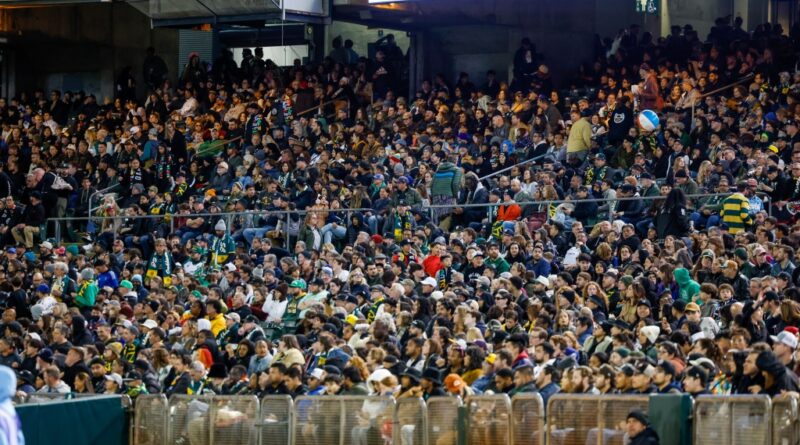
Oakland Roots SC are the only currently playing USL Championship team that is in a top 10 TV market with a venue that seats 15000, so they seem a great fit for USL Premier.
Beyond the Top 10
USL does not need to secure every top 10 TV market, but adding three to four major markets alongside Dallas and Oakland could significantly strengthen the league, particularly if one or two come from the top three.
Outside the top 10, USL is better positioned. Tampa Bay is the eleventh-largest market, though Al Lang Stadium would require expansion. USL Super League side Tampa Bay Sun FC is building a 15,000 seat stadium in Ybor City, which could offer a future option for the Rowdies. Phoenix, the twelfth-largest market, has multiple venue possibilities if Phoenix Rising’s current stadium can’t be expanded. Detroit, Miami, Sacramento, Indianapolis, Pittsburgh, San Antonio, and Hartford all present varying degrees of opportunity depending on stadium development and ownership ambition.
Ultimately, expansion teams will go where investors are willing to place them. However, the launch of USL Premier, combined with recent private equity investment, puts USL in the strongest position it has ever been to attract serious capital at the top of its system. With American ownership groups increasingly investing in clubs abroad, the introduction of promotion and relegation should not deter serious investors, and may instead become part of the league’s long-term appeal.
